What results can you expect from 75 Hard?
Nobody can honestly promise a number. Results depend on your starting point, the diet you choose, how you train and whether you finish. What the rules guarantee is volume: 75 days without alcohol, 150 workouts, 75 gallons of water, 750 pages read and 75 progress photos, if you complete it without a restart.
Here is the arithmetic of one completed run:
| Rule | Per day | Over 75 days |
|---|---|---|
| Workouts | 2 × 45 minutes | 150 workouts, at least 112.5 hours |
| Outdoor sessions | 1 | 75 |
| Water | 1 gallon | 75 gallons (about 284 liters) |
| Reading | 10 pages | 750 pages |
| Progress photos | 1 | 75 |
| Alcohol and cheat meals | 0 | 0 |
For scale, the US guidelines recommend at least 150 minutes of moderate activity a week plus two days of muscle strengthening (CDC). 75 Hard asks for at least 630 minutes a week, more than four times that minimum.
Is there research on 75 Hard results?
We could not find a peer-reviewed study of 75 Hard outcomes when we searched on October 31, 2026. Cleveland Clinic says that although fans share life-changing stories, "much of the success is anecdotal," with little to no scientific evidence that the program is beneficial. Before-and-after posts are real experiences, not controlled data.
That cuts both ways. There is no evidence the program fails, either; it simply has not been measured. The closest thing we found is a 2025 Clemson University master's thesis (Lamere, "TikTok Made Me Do It: #75Hard"). It did not study people doing the challenge. It found that 140 female college students reported a small increase in body dissatisfaction on one measure after watching #75Hard videos, and no significant change on the others.
Read that as a reason to be careful with comparison photos, not as a verdict on the program.
Why do 75 Hard before and after photos look so different?
Several things change between photos besides your body: lighting, posture, time of day, camera distance, clothing, pump from a workout, and what you ate and drank. A dramatic pair may be accurate, but you cannot tell from the image. Photos taken with the same setup every time are the only ones worth comparing.
Selection matters too. People who finish are far more likely to post than people who restart on day 12, so the photos you see online are not a fair sample of everyone who started.
What changes besides weight?
The rules target habits more than any single number. Finishers commonly describe changes in routine: training twice a day, planning meals, drinking water without thinking, reading daily and going 75 days without alcohol. Those are behaviors you can count on your tracker, which makes them more reliable results than a mirror.
Habit research supports the idea that daily repetition makes simple behaviors more automatic. In a well-known study, the median time to reach peak automaticity was 66 days, with a very wide range between people (Lally et al., 2009). That study did not involve 75 Hard; it is about habits in general.
How should you measure your own 75 Hard results?
Record the same few measures on days 1, 25, 50 and 75, under the same conditions each time: progress photos from the front, side and back, a tape measurement at the waist, a simple fitness test such as push-ups in one set or a timed mile, and a quick 1-to-10 rating of sleep, energy and mood.
Our free one-page log has those rows ready to fill in:
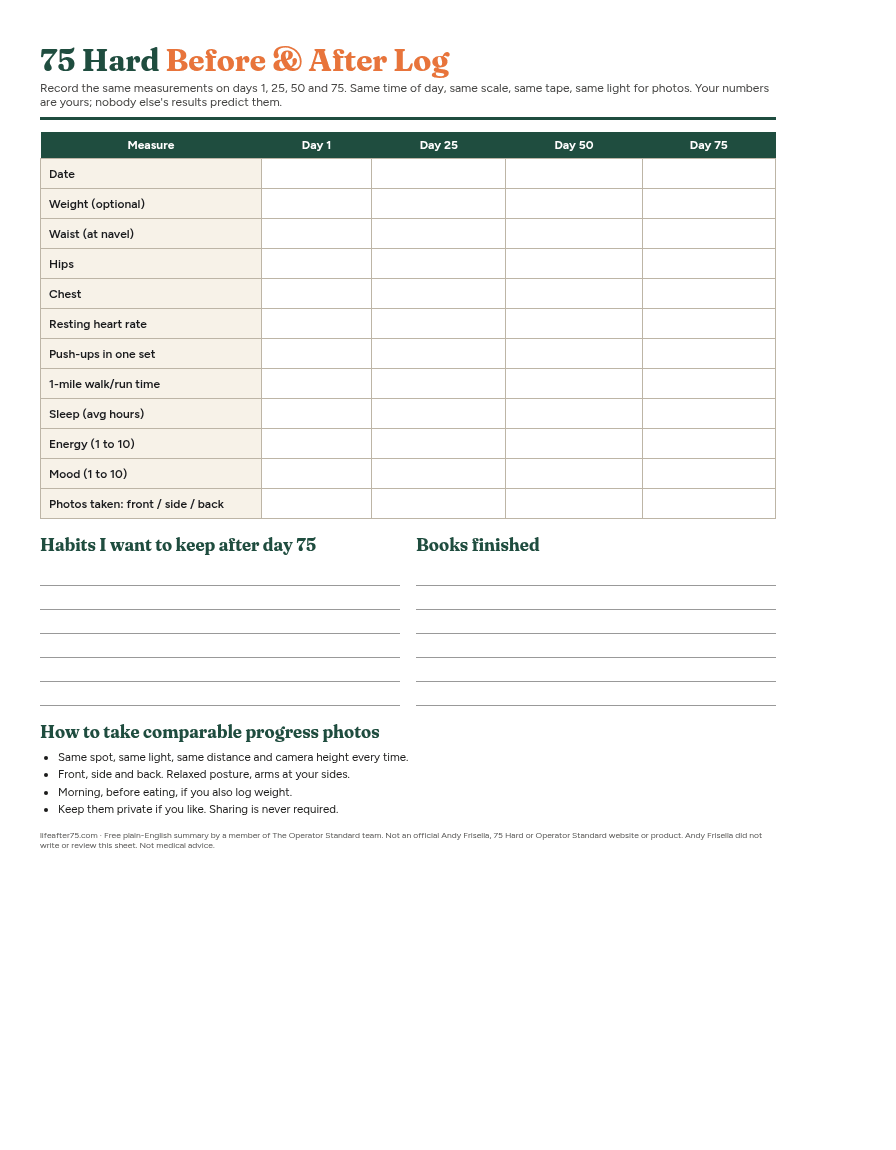
Tips for a comparison you can trust:
- Same spot, same light, same distance. Mark the floor with tape.
- Same time of day. Morning, before eating, if you also log weight.
- Relaxed posture. Arms at your sides, no flexing in one photo and not the other.
- Weight is optional. If the scale stresses you, leave that row blank. Waist and fitness tests tell you plenty.
- Keep it private if you want. The publisher's FAQ says progress photos do not have to be shared.
Is 75 Hard worth it for results?
It depends on what you want. If you want a structured test of consistency, it delivers a lot of repetition. If you want fat loss or strength specifically, a plan built for that goal, with rest days, may serve you better. Health writers also flag the daily volume and rigid rules as risky for some people.
The official program tells you to consult a physician before starting, and Penn State Health suggests gentler options such as 75 Soft for many people. Our rules guide covers the safety questions in more detail. This page is not medical advice.
What happens to results after day 75?
Habits fade if nothing replaces the structure. A common risk is a celebratory week that turns into a slow drift. Deciding before day 75 which two or three habits you will keep, and how you will track them, protects most of what you built.
Our life after 75 Hard guide has a simple day-76 plan, and the free tracker works for any custom challenge you set next.
Frequently asked questions
How much weight do people lose on 75 Hard?
There is no reliable average. No study has measured it, and the numbers in social posts are self-selected. Your diet choice and starting point matter most.
When should I take my 75 Hard before photo?
On the morning of day 1, before your first workout, in the spot you will use for every photo after.
Do I have to post my before and after?
No. The publisher's FAQ says progress photos can stay private.
Can I compare results if I restarted?
Yes. Keep your original day-1 photo and measurements, and note the attempt number on each log so you can see the whole journey.